
Heathrow Multi-Storey Car Park Ramp – Intrusive Survey & Remediation Design
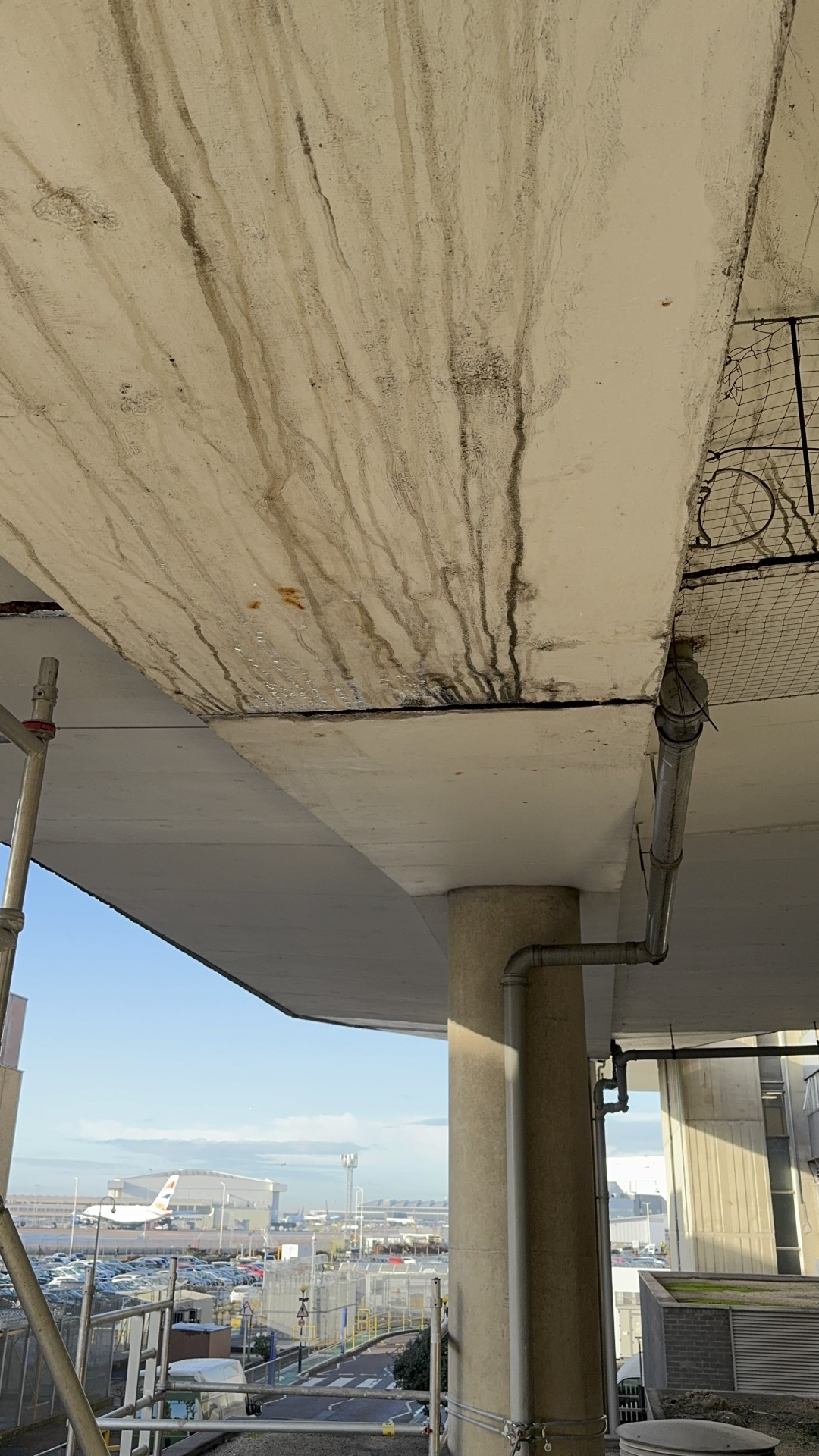
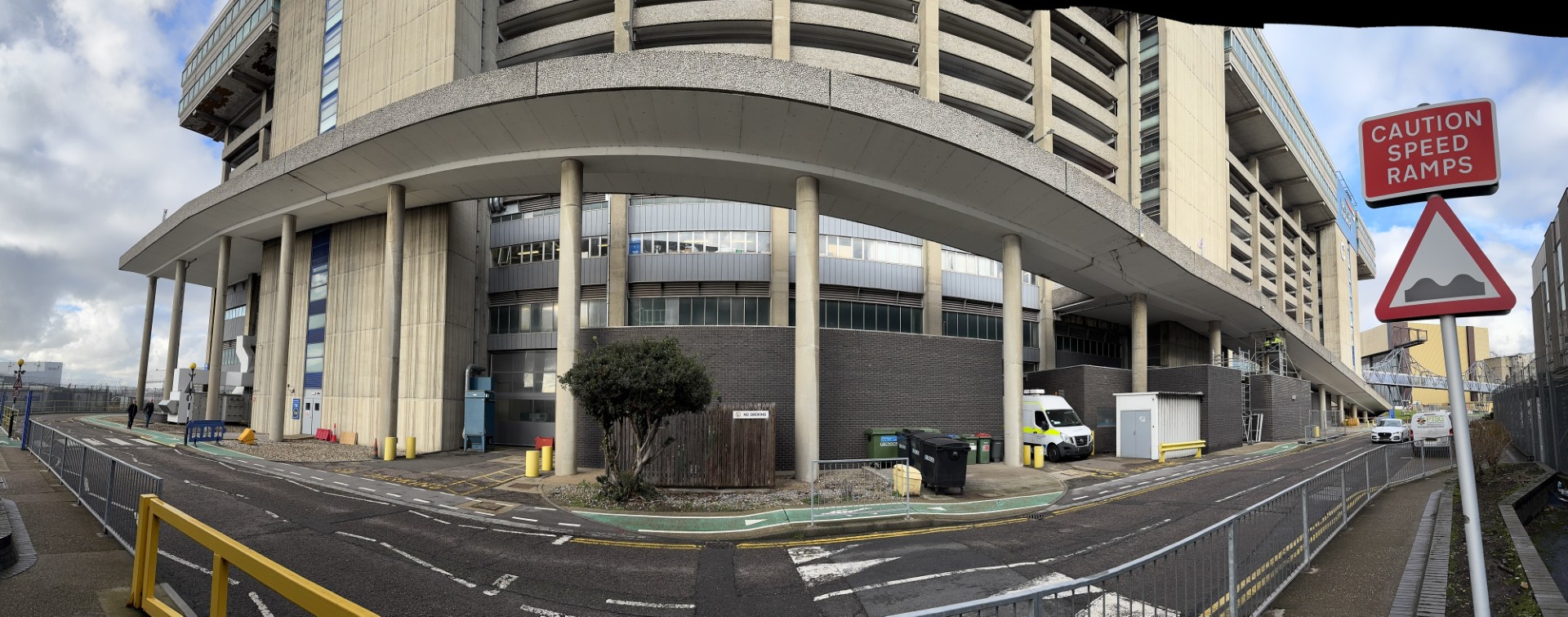
- Two-stage brief: Stage 1 intrusive survey at a single scaffolded soffit location; Stage 2 remediation design supported by drawings and calculations.
- Investigation focused on a priority area previously identified for concern and protected with debris netting.
- Structural form was treated as unconfirmed prior to opening-up; possible post-tensioning and hidden reinforcement risks were controlled through scanning and verification.
- Programme was aligned to scaffold access, live-site controls and focused engineering attendance within an operational airport environment.
- Deliverables included intrusive survey records, engineering assessment, repair scope definition, and a buildable remediation package for controlled delivery.
1. Unknown structural form and hidden reinforcement
The existing arrangement could not be fully confirmed before opening-up, increasing the risk of encountering unexpected reinforcement, tendon zones, or localised deterioration.
2. Live operational environment
The works had to be planned around access restrictions, safety controls, and the practical realities of working on an operational airport asset
3. High consequence of uncontrolled opening-up
Any intrusive work had to be tightly managed to avoid unnecessary breakout, unplanned damage, or escalation of local defects.
4. Translating limited access into a repairable scope
The engineering challenge was not just to inspect the defect, but to capture enough reliable evidence from a focused location to support a remediation design that a contractor could deliver safely.
1) Staged intrusive survey methodology
* Defined a focused close-access inspection strategy around the scaffolded soffit location.
* Structured the works so that each step of opening-up produced usable engineering evidence before progressing further.
* Required photo records, measured notes and condition mapping throughout the inspection.
2) Verification-first engineering assessment
* Treated the structural arrangement as unconfirmed until verified on site.
* Recommended scanning and reinforcement checks where required before intrusive works progressed.
* Assessed observed condition, likely load path implications, local deterioration mechanisms, and repair implications based on actual findings rather than assumptions.
3) Buildable remediation design
* Converted the survey findings into a practical remediation package with drawings and engineering calculations.
* Defined repair extents, breakout and reinstatement principles, and clear interfaces for contractor execution.
* Structured the outputs so the repair logic was directly tied to the observed condition.
4) Delivery controls and QA hold-points
* Issued hold-points for verification, breakout limits, reinforcement confirmation and repair sign-off.
* Built in stop-work triggers if unexpected tendon zones, reinforcement congestion or hidden deterioration were encountered.
* Required clear records and as-built evidence to support contractor delivery and close-out.
- Single-location intrusive survey targeted to answer the highest-value structural questions first.
- Possible post-tensioning risk treated as live until proven otherwise.
- Verification scanning and controlled opening-up used to reduce uncertainty safely.
- Repair design based on observed condition and measured evidence, not generic assumptions.
- Hold-point driven methodology developed to support safe contractor delivery on a live operational asset.
- The priority defect area was investigated under controlled close-access conditions, turning a previously uncertain condition into verifiable engineering evidence.
- The resulting findings were rationalised into a defined remediation scope supported by drawings, calculations and execution controls.
- Contractor delivery risk was reduced through a verification-first methodology, clear hold-points and explicit stop-work triggers.
- The project supported a practical route from inspection to repair planning without overextending the intrusive scope.
Intrusive survey planning · Close-access structural inspection · Defect mapping and evidence capture · Engineering assessment · Remediation design · Drawings and calculations · QA hold-points · Contractor delivery controls
Expertise in Investigation-Led Engineering
- Targeted structural investigations designed to answer the real engineering question
- Evidence-led decisions that reduce uncertainty, rework and delivery risk.
Buildable, Controlled Solutions
- Remediation details developed for real site conditions, access constraints and contractor sequencing.
- Clear QA hold-points, stop-work triggers and sign-off records built into the delivery approach.
Commitment to Safe Delivery
- Strong coordination with access specialists, contractors and stakeholders on live sites.
- Practical outputs that support safe execution, clear decision-making and controlled close-out.
Need support on a similar project? Contact us to discuss your requirement.